IF YOU FEEL ME,
I AM YOU
2026
Solo show at Ribot Gallery, Milan
With a text by Luisa Seipp
Solo show at Ribot Gallery, Milan
With a text by Luisa Seipp
If you feel me, I am you is less a title than a statement. It is an invitation to empathy that directly addresses the viewer, suggesting that recognition is born from shared experience: “If you understand what I am talking about, it is because it has happened to you as well.”
In her first solo exhibition at RIBOT Gallery, Simona Andrioletti presents a new body of work that continues her investigation into socio-political activism, systemic violence, and the psychological architectures we construct to survive. Gender-based violence, approached from an intersectional perspective, runs through the exhibition not as a theme, but as a condition that shapes bodies, behaviours, and the spaces we move through.
The exhibition unfolds across two levels. On the ground floor, large quilted works hang from metal structures assembled from construction-site scaffolding tubes. Made from different kind of padded fabrics, suspended by aluminium hooks laser-cut by the artist, these works appear at once soft and guarded. Their padded surfaces in blue and white carry stitched drawings made with a sewing machine, depicting fragments of medieval armour such as helmets and gloves. They read almost like instructions for dressing, for preparing the body for battle. Each quilt becomes an armour, or part of one, holding within it the unresolved tension between care and defence, vulnerability and aggression.
Quilting, a raised stitching technique that originated in the Mediterranean between the 13th and 14th centuries, is historically tied to protection. Andrioletti connects this lineage to medieval gambesons, padded garments worn by soldiers who could not afford metal armour. This history reverberates in the present. For gender-related minorities, protection is rarely optional. It is something learned, improvised, carried. This research extends beyond the quilts into a specially designed bomber jacket for the FLINTA community, equipped with non-violent self-defence tools like anti-spiking lids, a balaclava, and a high-decibel whistle. Objects that acknowledge both threat and agency.
Several quilts appear as fragments, joined by zippers.
These closures resemble scars as much as seams, marks of rupture and repair. The zipper becomes a quiet but powerful metaphor to create permanence, to imagine connection beyond separation. Dispersed parts may one day be reunited, closed again. In this gesture, Andrioletti proposes a community that exists across distance, sustained by the knowledge of possible reunion.
On the lower level of the gallery, the visitor must enter a cage in order to see the works. Some of its bars are composed of sentences written by the artist – Broken bones shattered souls – phrases that speak of fear, rage, and bodily memory. Here, language becomes structure and words become bars. Inside, alongside a quilt depicting an helmet, a pauldrons, and a cuirass, appears an image of a woman crying, two women holding each other closely, almost on the verge of a kiss. These figures recall Marian iconography from scenes of the Crucifixion as gestures of mourning, care, and collective grief. We sense that within the architecture of defence, vulnerability persists.
The cage functions as a metaphor for the mind after trauma. A structure built to protect, to contain, to remain alert. It is both confinement and survival strategy. To see the works, viewers must approach the bars, lean in, bring their bodies close. Looking becomes a physical act, an exercise in proximity and exposure.
Fabric, for Andrioletti, is also a carrier of memory. Part of a generation of women artists returning to the female lineage, she produced these works in Bergamo, in her grandmother’s house, which was once the site of a sewing workshop. Working side by side, the making of the quilts opened conversations between the two of them about gender-based violence, about motherhood and reproductive choices, sexual identity, and non-conformity. The act of making became a form of listening, of transmission, of shared reflection.
In the exhibition If you feel me, I am you, personal history and collective trauma are stitched together through gestures of protection and care. The exhibition does not offer resolution, but recognition. It insists that solidarity is not abstract or symbolic, but embodied. It is something learned, worn, and shared. It remains today both a necessity and a fragile, urgent possibility.
— Luisa Seipp
In her first solo exhibition at RIBOT Gallery, Simona Andrioletti presents a new body of work that continues her investigation into socio-political activism, systemic violence, and the psychological architectures we construct to survive. Gender-based violence, approached from an intersectional perspective, runs through the exhibition not as a theme, but as a condition that shapes bodies, behaviours, and the spaces we move through.
The exhibition unfolds across two levels. On the ground floor, large quilted works hang from metal structures assembled from construction-site scaffolding tubes. Made from different kind of padded fabrics, suspended by aluminium hooks laser-cut by the artist, these works appear at once soft and guarded. Their padded surfaces in blue and white carry stitched drawings made with a sewing machine, depicting fragments of medieval armour such as helmets and gloves. They read almost like instructions for dressing, for preparing the body for battle. Each quilt becomes an armour, or part of one, holding within it the unresolved tension between care and defence, vulnerability and aggression.
Quilting, a raised stitching technique that originated in the Mediterranean between the 13th and 14th centuries, is historically tied to protection. Andrioletti connects this lineage to medieval gambesons, padded garments worn by soldiers who could not afford metal armour. This history reverberates in the present. For gender-related minorities, protection is rarely optional. It is something learned, improvised, carried. This research extends beyond the quilts into a specially designed bomber jacket for the FLINTA community, equipped with non-violent self-defence tools like anti-spiking lids, a balaclava, and a high-decibel whistle. Objects that acknowledge both threat and agency.
Several quilts appear as fragments, joined by zippers.
These closures resemble scars as much as seams, marks of rupture and repair. The zipper becomes a quiet but powerful metaphor to create permanence, to imagine connection beyond separation. Dispersed parts may one day be reunited, closed again. In this gesture, Andrioletti proposes a community that exists across distance, sustained by the knowledge of possible reunion.
On the lower level of the gallery, the visitor must enter a cage in order to see the works. Some of its bars are composed of sentences written by the artist – Broken bones shattered souls – phrases that speak of fear, rage, and bodily memory. Here, language becomes structure and words become bars. Inside, alongside a quilt depicting an helmet, a pauldrons, and a cuirass, appears an image of a woman crying, two women holding each other closely, almost on the verge of a kiss. These figures recall Marian iconography from scenes of the Crucifixion as gestures of mourning, care, and collective grief. We sense that within the architecture of defence, vulnerability persists.
The cage functions as a metaphor for the mind after trauma. A structure built to protect, to contain, to remain alert. It is both confinement and survival strategy. To see the works, viewers must approach the bars, lean in, bring their bodies close. Looking becomes a physical act, an exercise in proximity and exposure.
Fabric, for Andrioletti, is also a carrier of memory. Part of a generation of women artists returning to the female lineage, she produced these works in Bergamo, in her grandmother’s house, which was once the site of a sewing workshop. Working side by side, the making of the quilts opened conversations between the two of them about gender-based violence, about motherhood and reproductive choices, sexual identity, and non-conformity. The act of making became a form of listening, of transmission, of shared reflection.
In the exhibition If you feel me, I am you, personal history and collective trauma are stitched together through gestures of protection and care. The exhibition does not offer resolution, but recognition. It insists that solidarity is not abstract or symbolic, but embodied. It is something learned, worn, and shared. It remains today both a necessity and a fragile, urgent possibility.
— Luisa Seipp
(ITA)If you feel me, I am you più che un titolo è uno statement. È un invito all’empatia che si rivolge direttamente allo spettatore, suggerendo che il riconoscimento nasce dall’esperienza condivisa: «Se capisci di cosa sto parlando, è perché è successo anche a te».
Nella sua prima mostra personale a RIBOT gallery, Simona Andrioletti presenta un nuovo nucleo di opere che prosegue la sua indagine sull’attivismo socio-politico, la violenza sistemica e le architetture psicologiche che costruiamo per sopravvivere. La violenza di genere, affrontata da una prospettiva intersezionale, attraversa la mostra non come tema, ma come condizione che modella i corpi, i comportamenti e gli spazi che abitiamo.
La mostra si sviluppa su due livelli. Al piano terra, grandi lavori trapuntati sono sospesi a strutture metalliche assemblate con tubi da impalcatura. Realizzate con diversi tipi di tessuti imbottiti e appese tramite ganci in alluminio tagliati al laser dall’artista, queste opere appaiono al tempo stesso morbide e difensive. Le loro superfici imbottite, nei toni del blu e del bianco, presentano disegni cuciti a macchina che raffigurano frammenti di armature medievali, come elmi e guanti. Sembrano quasi istruzioni per vestirsi, per preparare il corpo alla battaglia. Ogni trapunta diventa un’armatura, o una parte di essa, trattenendo al proprio interno la tensione irrisolta tra cura e difesa, vulnerabilità e aggressione.
La trapuntatura, tecnica di cucitura in rilievo originatasi nel Mediterraneo tra il XIII e il XIV secolo, è storicamente legata alla protezione. Andrioletti rintraccia questa tradizione nei gambesoni medievali, indumenti imbottiti indossati dai soldati che non potevano permettersi un’armatura metallica. Questa storia risuona nel presente. Per le minoranze di genere, la protezione è raramente opzionale: è qualcosa che si apprende, si improvvisa, si porta con sé. Questa ricerca si estende oltre i trapunti in una giacca bomber appositamente progettata per la comunità FLINTA, dotata di strumenti di autodifesa non violenti come tappi anti-spiking, un passamontagna e un fischietto ad alta intensità sonora. Oggetti che riconoscono insieme la minaccia e la capacità di agire.
Alcuni trapunti appaiono come frammenti, uniti da cerniere. Queste chiusure somigliano tanto a cicatrici quanto a cuciture, segni di rottura e di riparazione. La cerniera diventa una metafora silenziosa ma potente per creare permanenza, per immaginare una connessione oltre la separazione. Parti disperse potranno un giorno riunirsi, richiudersi. In questo gesto, Andrioletti propone una comunità che esiste nella distanza, sostenuta dalla consapevolezza di una possibile riunione.
Al piano inferiore della galleria, lə visitatorə devono entrare in una gabbia per poter vedere le opere. Alcune delle sue sbarre sono composte da frasi scritte dall’artista — Broken bones shattered souls — espressioni che parlano di paura, rabbia e memoria corporea. Qui il linguaggio diventa struttura e le parole diventano sbarre. All’interno, accanto a una trapunta che raffigura un elmo, degli spallacci e una corazza, compare l’immagine di una donna che piange e di due donne che si stringono l’una all’altra, quasi sul punto di baciarsi. Queste figure richiamano l’iconografia mariana delle scene della Crocifissione, come gesti di lutto, cura e dolore collettivo. Si percepisce che, all’interno dell’architettura della difesa, la vulnerabilità persiste.
La gabbia funziona come metafora della mente dopo il trauma: una struttura costruita per proteggere, contenere, restare vigile. È al tempo stesso confinamento e strategia di sopravvivenza. Per vedere le opere, lə spettatorə devono avvicinarsi alle sbarre, sporgersi, portare i propri corpi a ridosso. Guardare diventa un atto fisico, un esercizio di prossimità ed esposizione.
Per Andrioletti, il tessuto è anche un veicolo di memoria. Parte di una generazione di artiste che tornano a una genealogia femminile, ha realizzato queste opere a Bergamo, nella casa della nonna, un tempo sede di un laboratorio di cucito. Lavorando fianco a fianco, la realizzazione dei trapunti ha favorito tra di loro conversazioni sulla violenza di genere, sulla maternità e le scelte riproduttive, sull’identità sessuale e la non conformità. L’atto del fare si è trasformato in una forma di ascolto, di trasmissione, di riflessione condivisa.
Nella mostra If you feel me, I am you, la storia personale e il trauma collettivo vengono cuciti insieme attraverso gesti di protezione e di cura. La mostra non offre una risoluzione, ma un riconoscimento. Insiste sul fatto che la solidarietà non è astratta né simbolica, ma incarnata. È qualcosa che si apprende, si indossa, si condivide. Oggi rimane al tempo stesso una necessità e una possibilità fragile e urgente.
— Luisa Seipp
Nella sua prima mostra personale a RIBOT gallery, Simona Andrioletti presenta un nuovo nucleo di opere che prosegue la sua indagine sull’attivismo socio-politico, la violenza sistemica e le architetture psicologiche che costruiamo per sopravvivere. La violenza di genere, affrontata da una prospettiva intersezionale, attraversa la mostra non come tema, ma come condizione che modella i corpi, i comportamenti e gli spazi che abitiamo.
La mostra si sviluppa su due livelli. Al piano terra, grandi lavori trapuntati sono sospesi a strutture metalliche assemblate con tubi da impalcatura. Realizzate con diversi tipi di tessuti imbottiti e appese tramite ganci in alluminio tagliati al laser dall’artista, queste opere appaiono al tempo stesso morbide e difensive. Le loro superfici imbottite, nei toni del blu e del bianco, presentano disegni cuciti a macchina che raffigurano frammenti di armature medievali, come elmi e guanti. Sembrano quasi istruzioni per vestirsi, per preparare il corpo alla battaglia. Ogni trapunta diventa un’armatura, o una parte di essa, trattenendo al proprio interno la tensione irrisolta tra cura e difesa, vulnerabilità e aggressione.
La trapuntatura, tecnica di cucitura in rilievo originatasi nel Mediterraneo tra il XIII e il XIV secolo, è storicamente legata alla protezione. Andrioletti rintraccia questa tradizione nei gambesoni medievali, indumenti imbottiti indossati dai soldati che non potevano permettersi un’armatura metallica. Questa storia risuona nel presente. Per le minoranze di genere, la protezione è raramente opzionale: è qualcosa che si apprende, si improvvisa, si porta con sé. Questa ricerca si estende oltre i trapunti in una giacca bomber appositamente progettata per la comunità FLINTA, dotata di strumenti di autodifesa non violenti come tappi anti-spiking, un passamontagna e un fischietto ad alta intensità sonora. Oggetti che riconoscono insieme la minaccia e la capacità di agire.
Alcuni trapunti appaiono come frammenti, uniti da cerniere. Queste chiusure somigliano tanto a cicatrici quanto a cuciture, segni di rottura e di riparazione. La cerniera diventa una metafora silenziosa ma potente per creare permanenza, per immaginare una connessione oltre la separazione. Parti disperse potranno un giorno riunirsi, richiudersi. In questo gesto, Andrioletti propone una comunità che esiste nella distanza, sostenuta dalla consapevolezza di una possibile riunione.
Al piano inferiore della galleria, lə visitatorə devono entrare in una gabbia per poter vedere le opere. Alcune delle sue sbarre sono composte da frasi scritte dall’artista — Broken bones shattered souls — espressioni che parlano di paura, rabbia e memoria corporea. Qui il linguaggio diventa struttura e le parole diventano sbarre. All’interno, accanto a una trapunta che raffigura un elmo, degli spallacci e una corazza, compare l’immagine di una donna che piange e di due donne che si stringono l’una all’altra, quasi sul punto di baciarsi. Queste figure richiamano l’iconografia mariana delle scene della Crocifissione, come gesti di lutto, cura e dolore collettivo. Si percepisce che, all’interno dell’architettura della difesa, la vulnerabilità persiste.
La gabbia funziona come metafora della mente dopo il trauma: una struttura costruita per proteggere, contenere, restare vigile. È al tempo stesso confinamento e strategia di sopravvivenza. Per vedere le opere, lə spettatorə devono avvicinarsi alle sbarre, sporgersi, portare i propri corpi a ridosso. Guardare diventa un atto fisico, un esercizio di prossimità ed esposizione.
Per Andrioletti, il tessuto è anche un veicolo di memoria. Parte di una generazione di artiste che tornano a una genealogia femminile, ha realizzato queste opere a Bergamo, nella casa della nonna, un tempo sede di un laboratorio di cucito. Lavorando fianco a fianco, la realizzazione dei trapunti ha favorito tra di loro conversazioni sulla violenza di genere, sulla maternità e le scelte riproduttive, sull’identità sessuale e la non conformità. L’atto del fare si è trasformato in una forma di ascolto, di trasmissione, di riflessione condivisa.
Nella mostra If you feel me, I am you, la storia personale e il trauma collettivo vengono cuciti insieme attraverso gesti di protezione e di cura. La mostra non offre una risoluzione, ma un riconoscimento. Insiste sul fatto che la solidarietà non è astratta né simbolica, ma incarnata. È qualcosa che si apprende, si indossa, si condivide. Oggi rimane al tempo stesso una necessità e una possibilità fragile e urgente.
— Luisa Seipp
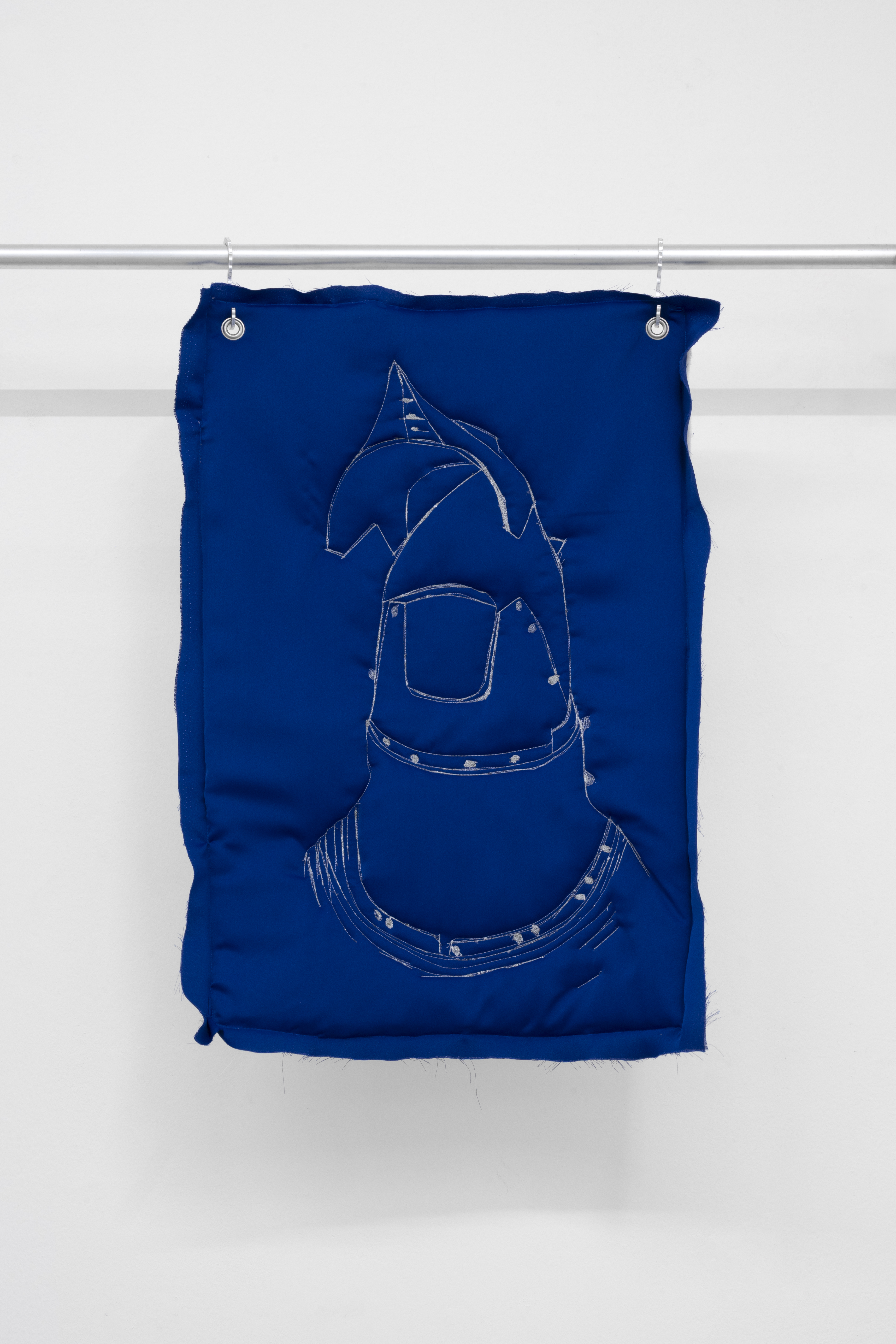
Simona Andrioletti, If you feel me, I am you (Pointed helmet), 2026, hand-drawn machine quilting on padded fabric, custom hooks, cm 80x56
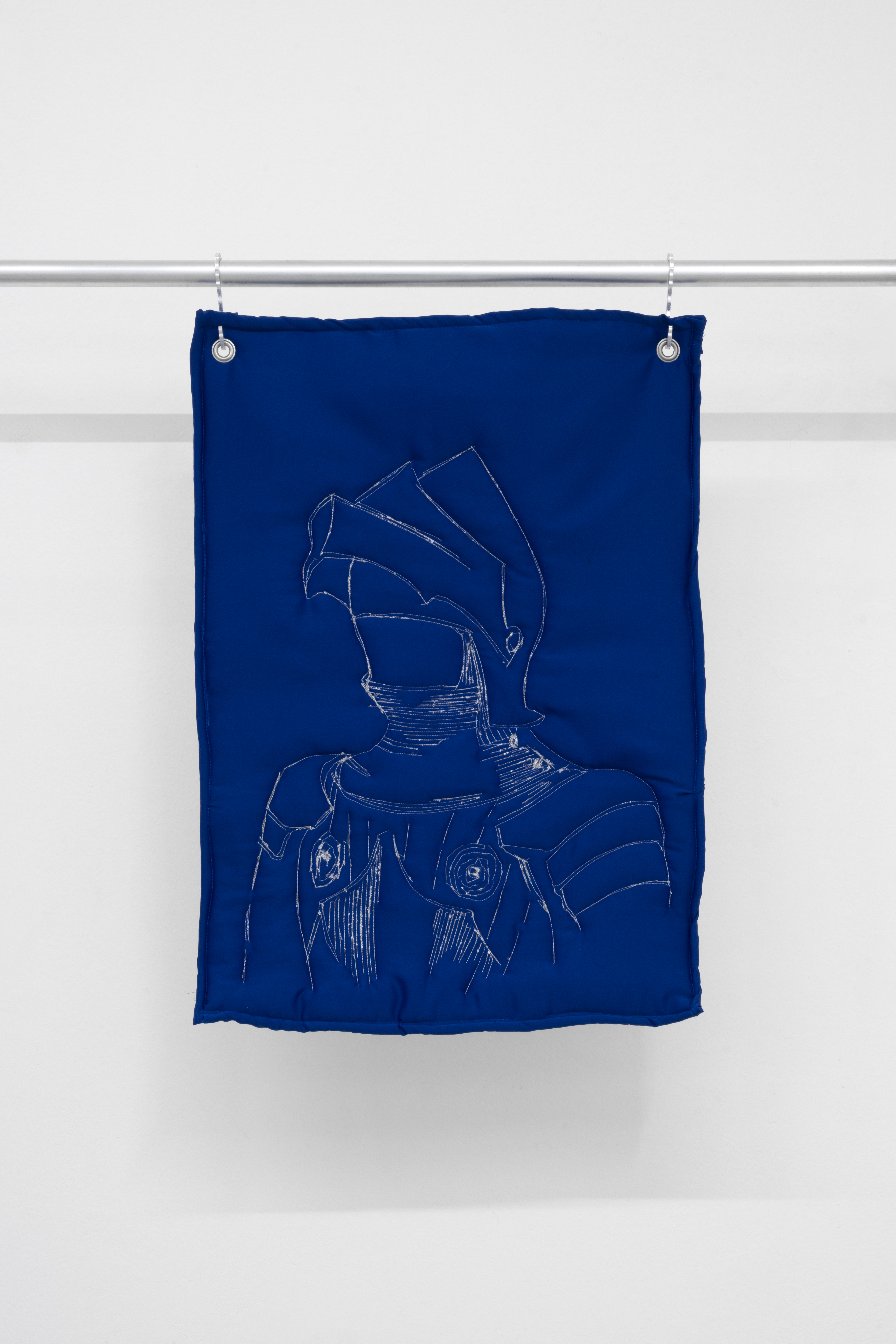
Simona Andrioletti, If you feel me, I am you (Bust with helmet and cuiras), 2026, hand-drawn machine quilting on padded fabric, custom hooks, cm 74x52
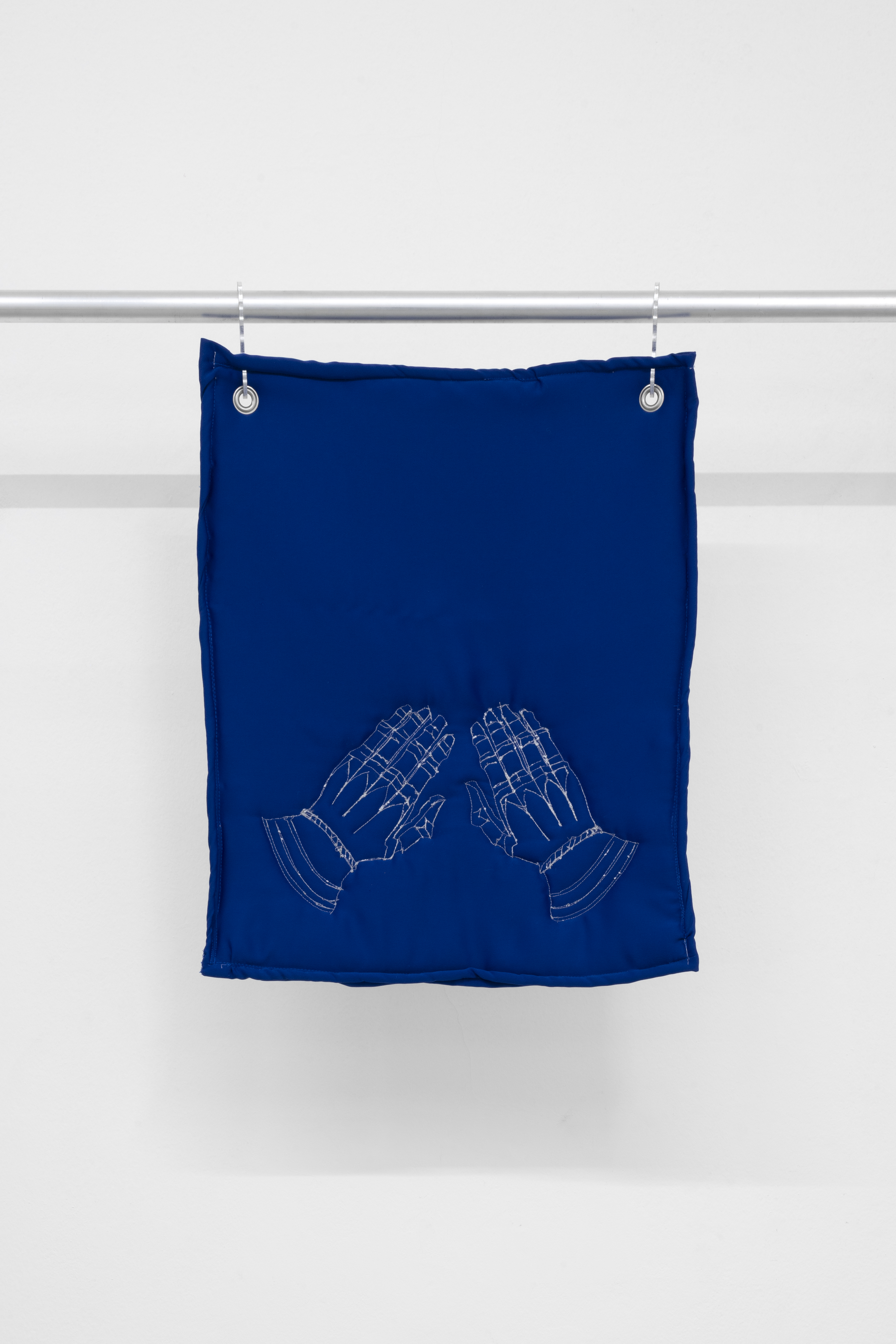
Simona Andrioletti, If you feel me, I am you (Gauntlets, hand vulva symbol), 2026, hand-drawn machine quilting on padded fabric, custom hooks, cm 56x48
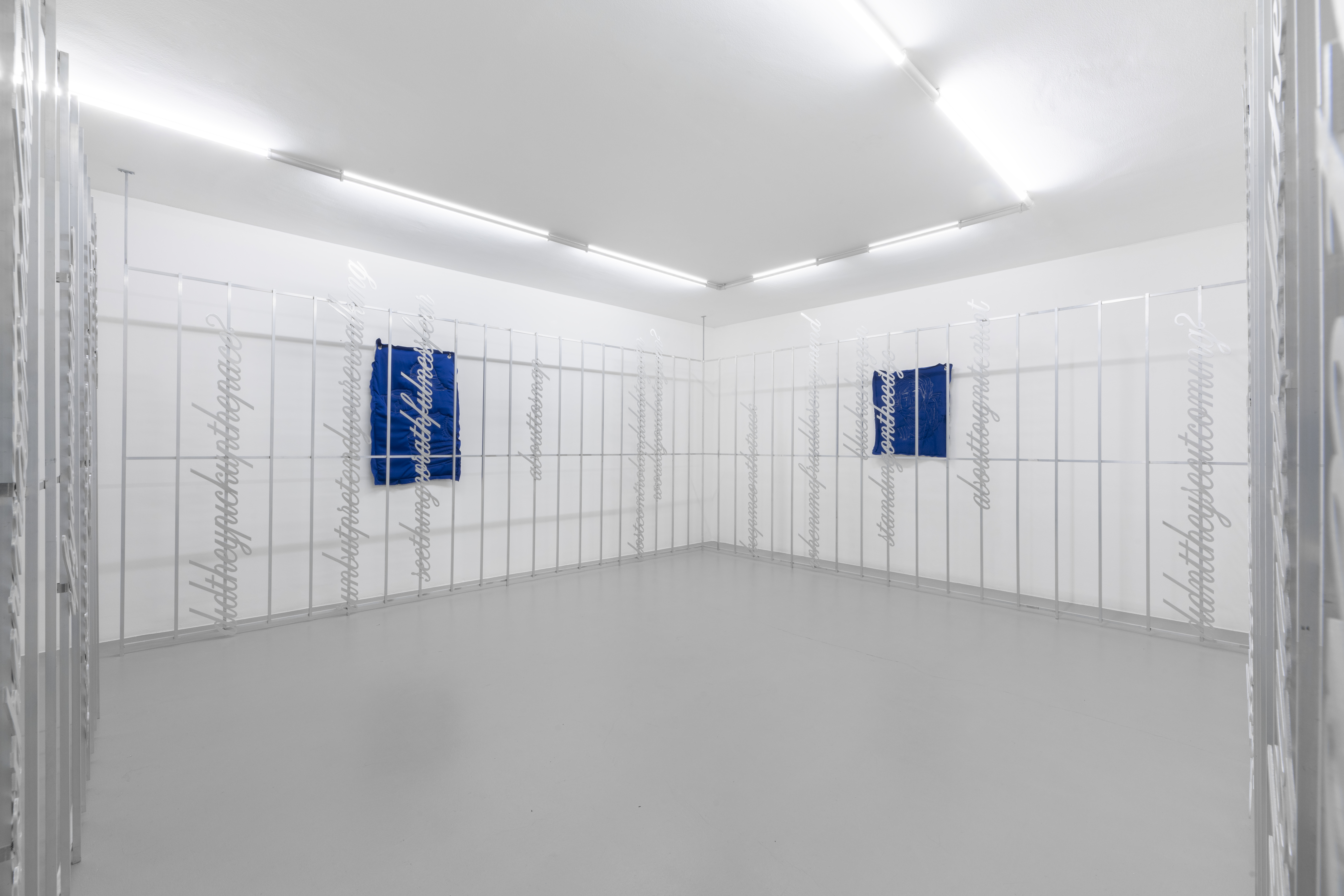
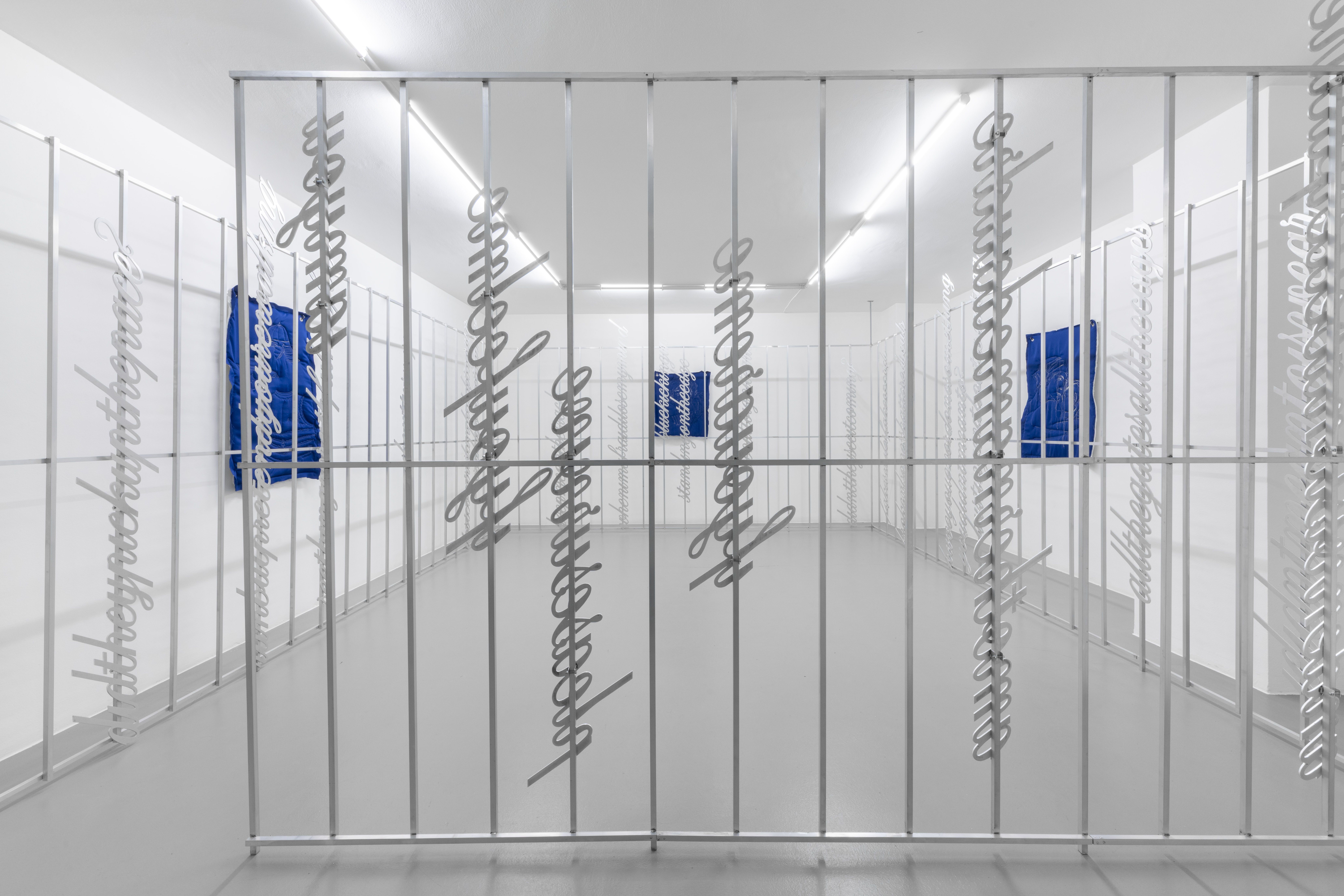
Simona Andrioletti, If you feel me, I am you, 2026, installation view @RIBOT


Simona Andrioletti, If you feel me, I am you (White helmets)/, /Cuirass) / (Armor gauntlets) / (Greaves), 2026
hand-drawn machine quilting on padded fabric, custom hooks, metal rings and zippers, cm 260x100 approx.
hand-drawn machine quilting on padded fabric, custom hooks, metal rings and zippers, cm 260x100 approx.
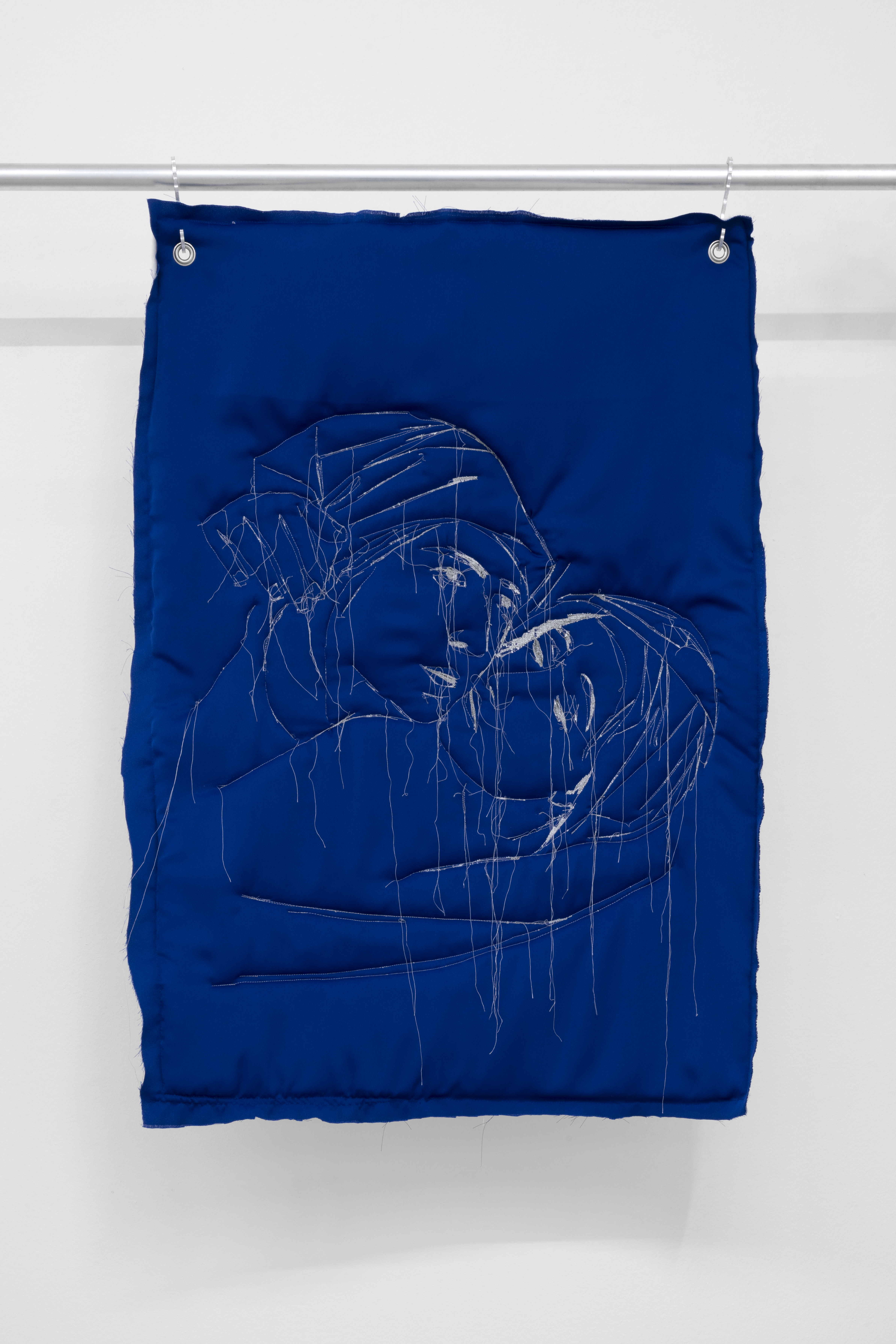
Simona Andrioletti, If you feel me, I am you (Kiss), 2026
hand-drawn machine quilting on padded fabric, custom hooks, cm 98x73
hand-drawn machine quilting on padded fabric, custom hooks, cm 98x73
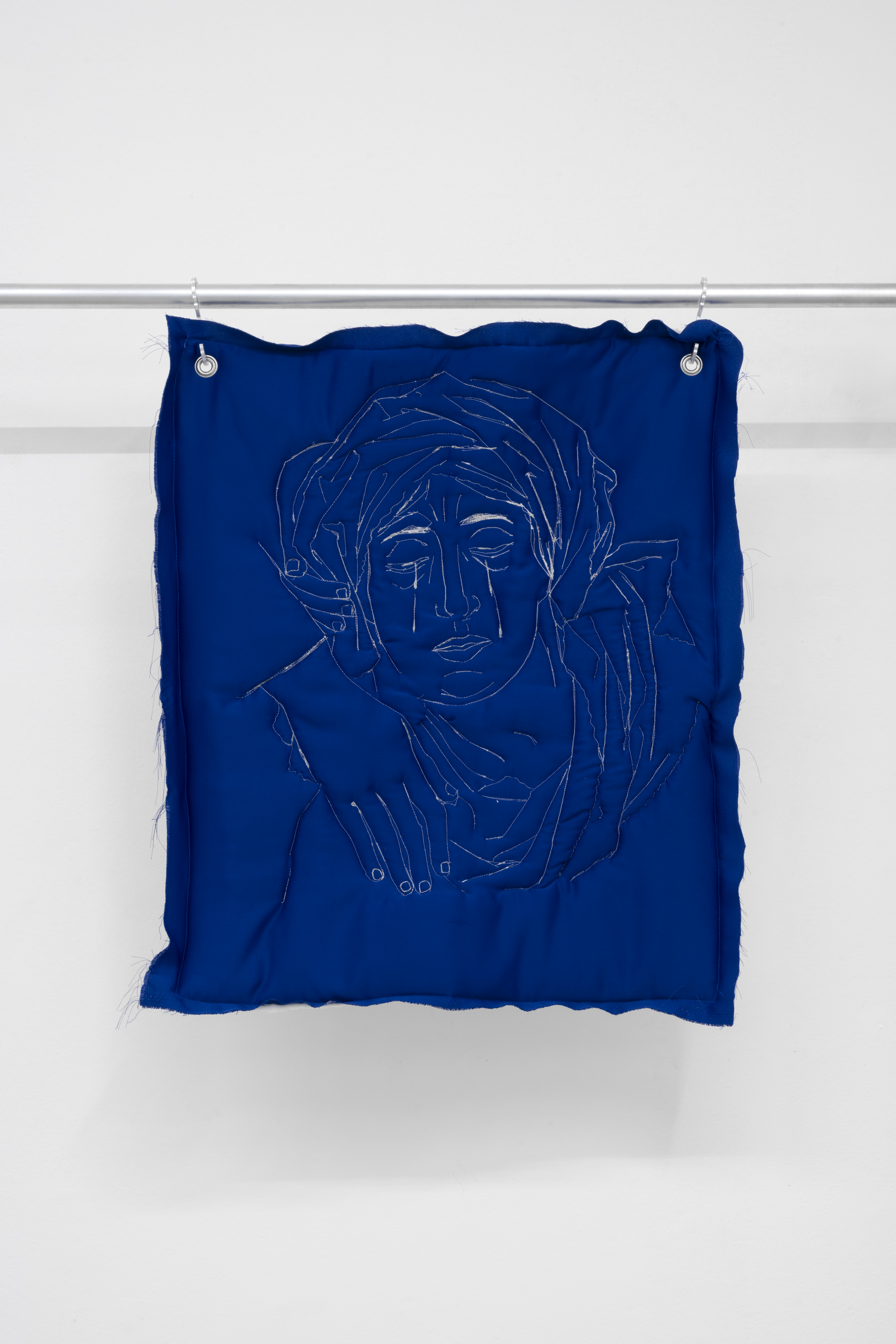
Simona Andrioletti, If you feel me, I am you (Madonna), 2026
hand-drawn machine quilting on padded fabric, custom hooks, cm 75x65
hand-drawn machine quilting on padded fabric, custom hooks, cm 75x65
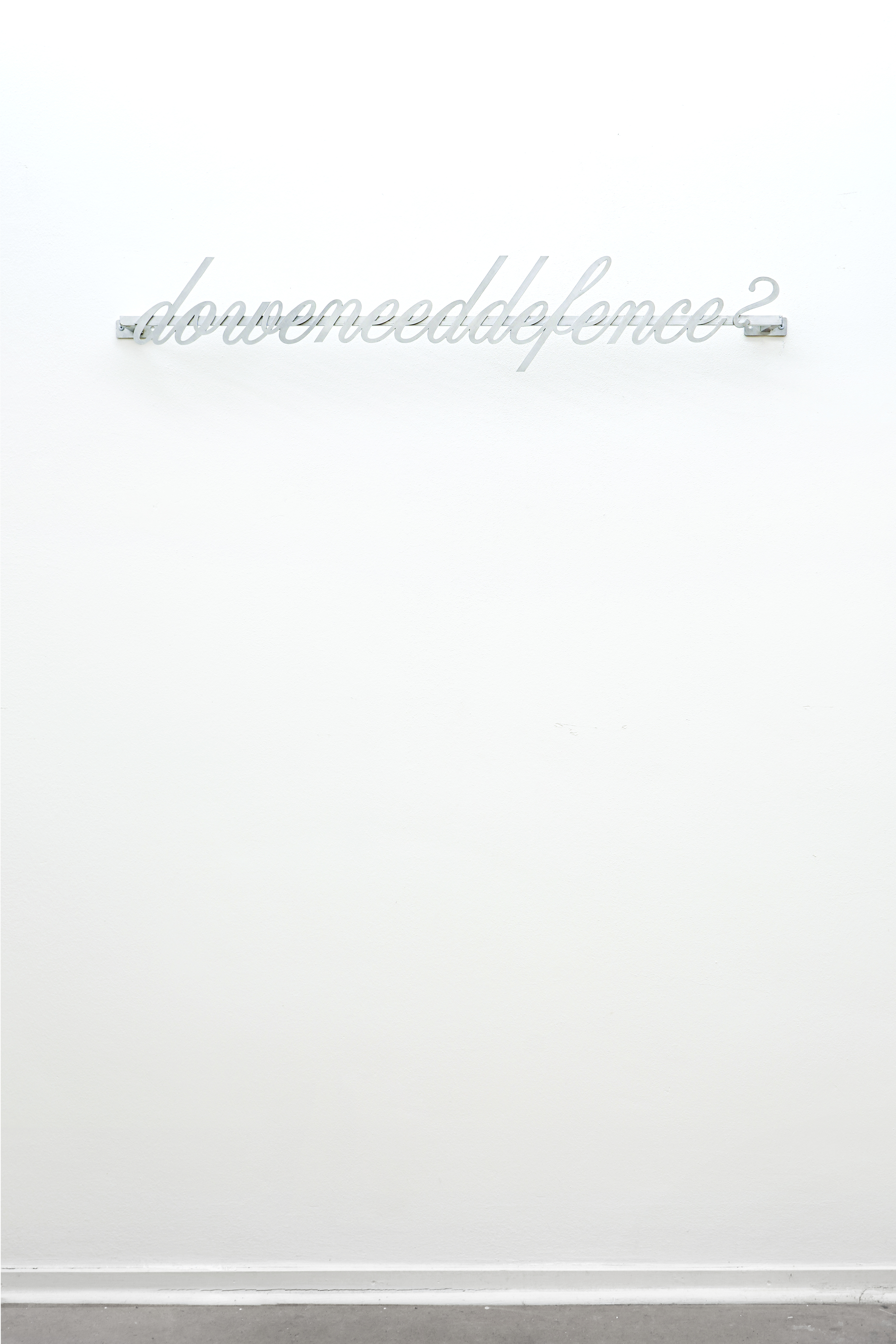
Simona Andrioletti, Do we need defence?, 2024
alluminio tagliato a laser e saldatura, cm 22 x 110 x 12,5, ed. 2 + 1 AP
alluminio tagliato a laser e saldatura, cm 22 x 110 x 12,5, ed. 2 + 1 AP
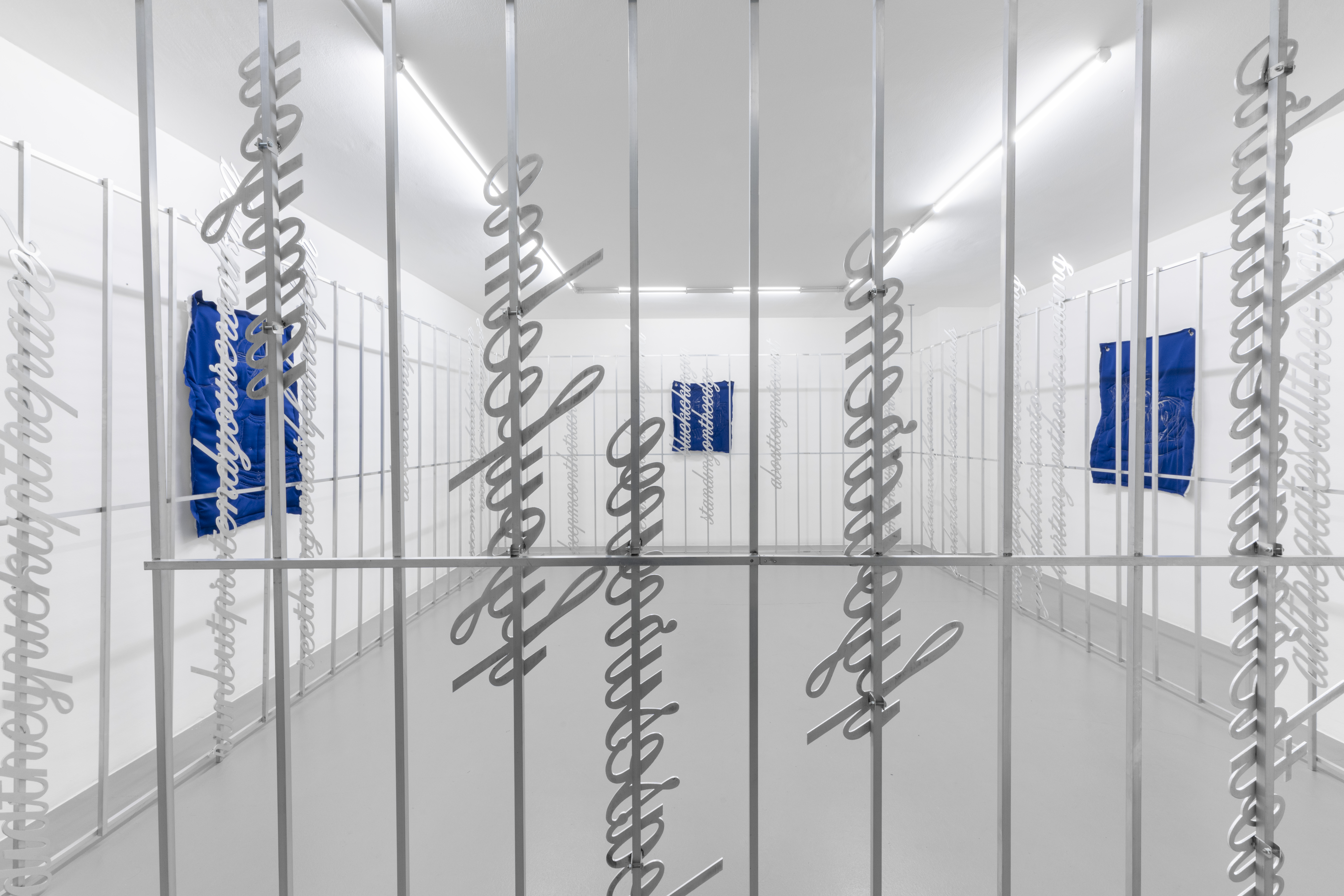
Simona Andrioletti, If you feel me, I am you, 2026, installation view @RIBOT